
I was told in my dojo, that if you want to carry a weapon, you should only do that if you are ready to use it to the end. Let me give an example: If you carry a knife, you have a big chance to draw it in a point or brink of a physical conflict.
Thus it is of vital importance to understand that carrying a weapon means that you should obtain the skill and will to use it in the way it is meant to use; Otherwise it is best to disgard those weapons. If you carry a blade or a gun and want to draw it just for scaring of the attacker there is a serious risk that the attacker(s) gets more provoked and/or so scared that he/she tries to grab your weapon and use it against you, or draw his/her own weapon.
Some Christians want to forbid all kinds of weapons, even unarmed self-defence from their brethren and to justify this they (mis)quote Jesus' words like:
"Return your sword to its place, for all those who take the sword will perish by the sword" (Matthew 26:52).
Of course Jesus was strongly against violence, but he did not forbid self-defence in all its forms in this situation. Christians who use this verse to do so fail to see that Jesus said Peter not to throw his sword away, but to return it to its place (for the possible need in another time). Also, Jesus himself had earlier instructed the disciples to obtain swords! We can read at Luke 22:36-28:
"Then he said to them: “But now let the one that has a purse take it up, likewise also a food pouch; and let the one having no sword sell his outer garment and buy one. For I tell YOU that this which is written must be accomplished in me, namely, ‘And he was reckoned with lawless ones.’ For that which concerns me is having an accomplishment.” Then they said: “Lord, look! here are two swords.” He said to them: “It is enough.”
Clearly did the Lord not told his disciples to commit a sin!
Also the ultra-pacifists use the verse: "However, I say to YOU: Do not resist him that is wicked; but whoever slaps you on your right cheek, turn the other also to him" (Matthew 5:39).
Actually people who do not resist violence ever would turn away or flee from the situation of being hit. But many scholars claim that slapping to cheek was a claim of one's superiority over other, in turn, turning another cheek was an assertion to be equal with the one who slaps (Source for the interpretation of slapping to cheek: ACC website).
It is true that God does not want us to kill. However, if we or our loved ones are in danger to be killed, it is the attacker who has broken God's commandments of not killing, and if the attacker happens to perish in attempt, "his blood is upon his own head", for it is written: "For whatever a man is sowing, this he will also reap" (Galatians 6:7b). If we fail to save an innocent life, it may be that our conscience blames us for permitting that happen.
Certainly the important aspect of the issue are the Christian ethics. It is clearly told us in the Christian Scriptures that we ought to love our enemies. It is evident that the true Christian wants to avoid conflict at all cost and when it is unavoidable, the Christian tries to apply as little force as possible to subdue the attacker. This in mind, it is usually best and suitable not to carry any weapon at all and learn as much about diplomatics, getting away and using unarmed, non-leathel self-defense. If necessary to obtain and carry the tools of self preservation, non-lethal are to be recommended as first option. Non-leathal weapons included for example pepper spray, stun gun and baton. Also, from the more leathal arsenal, the so-called archaic weapons suit fine in the ethics of the Christian Knight. These include for example, the sword, dagger, throwing blades, sticks and staffs, bows and spears. Let me assure you that the blade in its various forms is as dangerous and convinient as in earlier eras (at least in civil environment and especially in countries like mine, where hand guns are not very common). There are also times and places where guns are necessary, both because of the beast and men. If a Christian should own a gun, one should learn to use it as effectively as possible, in order to avoid accidents and friendly fire.
"With great power comes a great responsibility", goes the saying. This means responsibility to apply force when necessary, and also to use reason and ethics to which extence the force should be applied.
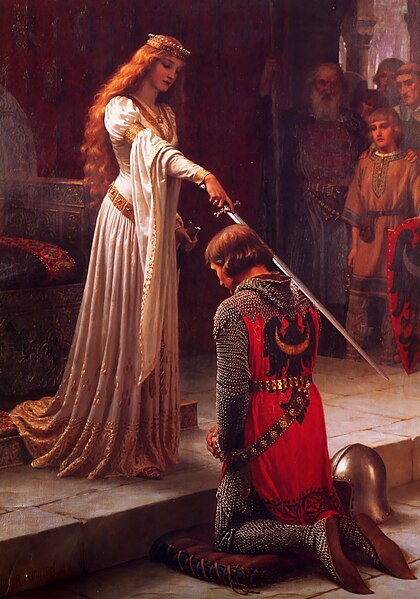
Christians with a calling to protect (the 'knights') should decide for example in an encounter of sudden terrorist attack, if it is morally wrong to let fifty people die instead of taking down one or two attackers, because of one's lack of manly valor and self-sarfice and/or misguided extremism in understanding of the doctrine of Christian non-violence.